TerraBlick Logo

TerraBlick

Engineering case study · 2026

From receipt noise to useful signals.

How TerraBlick turns unstructured shopping receipts into explainable sustainability insights and practical reminders—and the decisions made along the way.

ROLE
Full-stack engineering
SURFACE
Web + API
STAGE
Production

Project summary

Duration
2025 – Present
Team
Solo
Core technologies
Next.js · NestJS · PostgreSQL · AWS · Groq AI

01 / The problem

Why receipts?

People increasingly want to make more sustainable choices, yet understanding the impact of everyday consumption remains difficult.

Many carbon footprint tools rely on generic questionnaires. They ask people to remember and summarize their habits, which creates distance between the answer and what actually happens.

Shopping receipts offered a different starting point: instead of asking people what they think they buy, why not learn from what they actually purchase?

Starting observation

A receipt is imperfect, but it is concrete. That single observation became the starting point for TerraBlick.

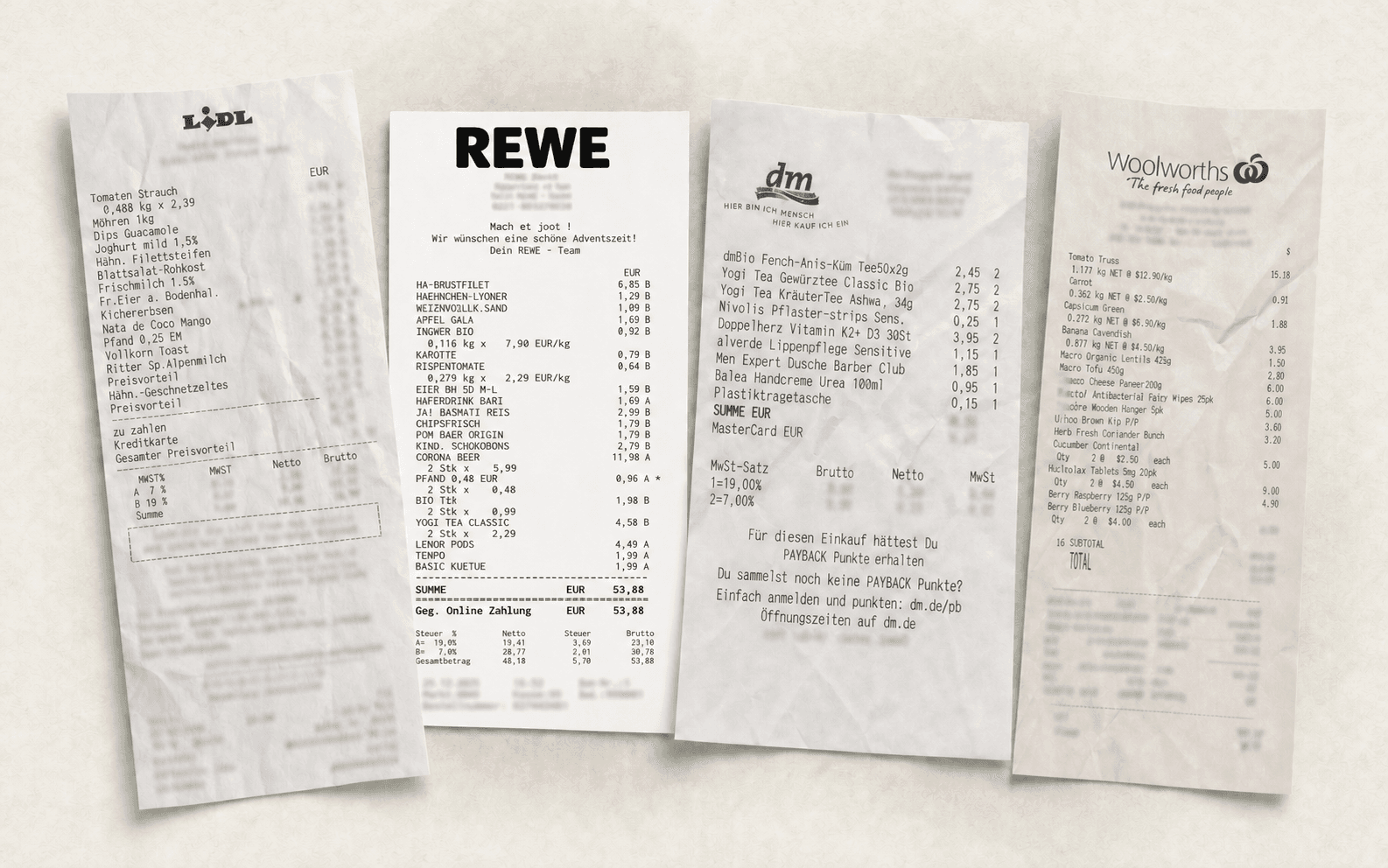
A collage of grocery and household receipts from different retailers and countries
Different retailers · languages · layouts · levels of scan quality

Input

Abbreviated, multilingual text with inconsistent layouts and imperfect scans.

Missing layer

No stable product identity connects a single purchase to longer-term behavior.

Needed output

Useful guidance that communicates uncertainty instead of hiding it.

“The challenge was never reading receipts. The challenge was deciding what could be concluded from them with confidence.”

02 / Product philosophy

Designing for encouragement

TerraBlick was never intended to punish people for what they buy.

Sustainability products often communicate through guilt. TerraBlick deliberately takes a different approach: reward positive decisions, make progress visible, and encourage gradual change without pretending that consumption is simple.

Inform

Explain the signal and its limits.

Encourage

Recognize better choices and progress.

Respect

Keep the user in control of decisions.

The application should inform rather than judge. That principle affects the reward model, the language, and how uncertainty is presented.

03 / System shape

A pipeline, not a single intelligent step

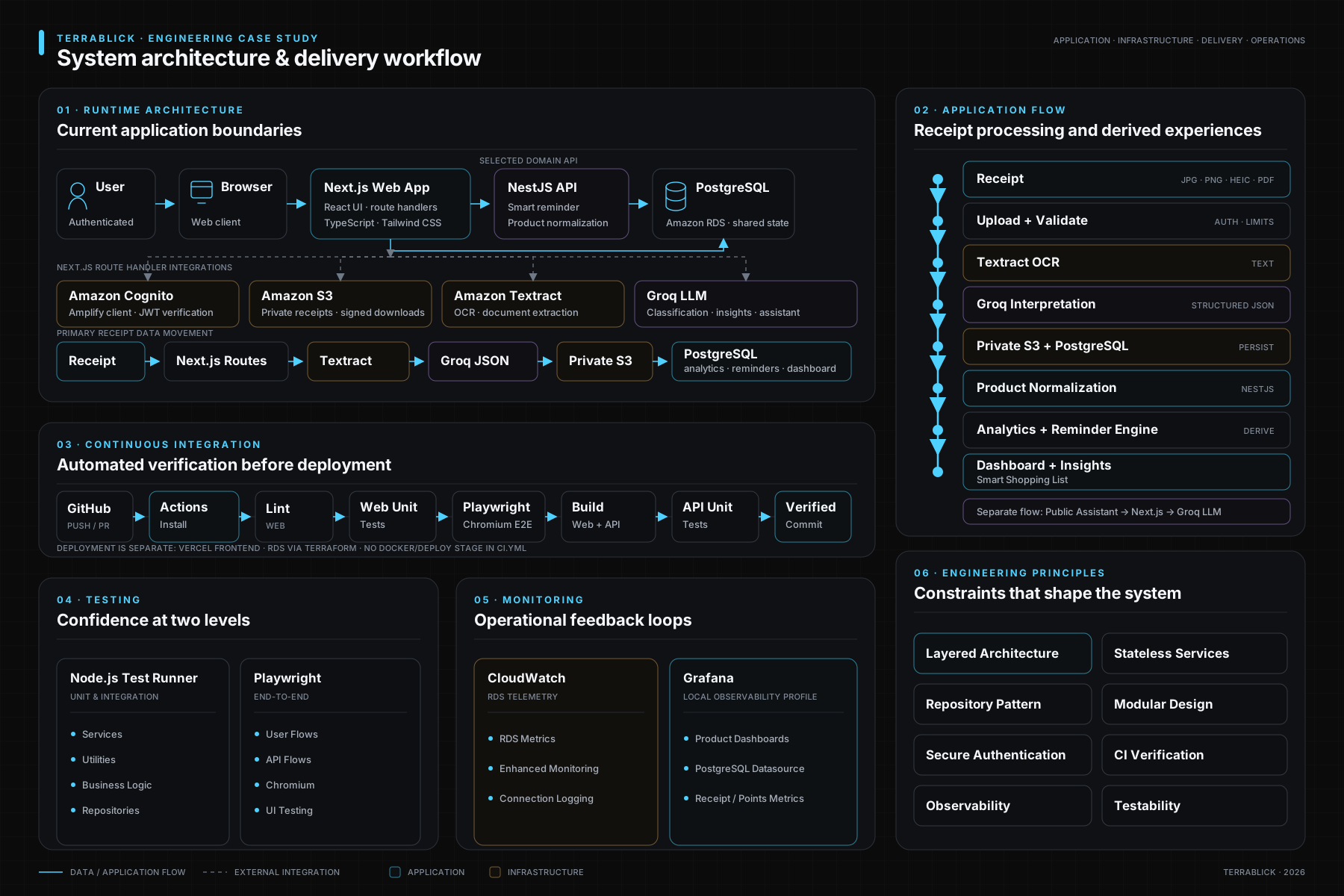
The architecture mirrors the uncertainty of the problem by separating extraction, interpretation, normalization, and analysis into distinct stages.

TerraBlick system architecture showing the web application, API, data services, receipt pipeline, delivery workflow, and operational boundaries
System architecture & delivery workflowApplication · infrastructure · operations
01

Upload

Validate type, size, ownership

02

Extract

Textract returns document text

03

Interpret

Structured JSON identifies products

04

Normalize

Aliases and family rules converge

05

Persist

Receipt and item records are stored

06

Derive

Insights and reminders are computed

Runtime boundaries

HIGH LEVEL
ClientNext.js + React
IdentityAmazon Cognito
DocumentS3 + Textract
DomainNestJS services + engines
StatePostgreSQL

Why layered services?

External providers, persistence, and AI models are expected to evolve over time. The business rules should remain stable despite those changes.

Responsibilities are separated across controllers, services, repositories, and domain logic to keep the system maintainable and easier to evolve.

Test rules without I/O
Replace data access
Scale stateless services
Inspect stage failures

04 / Key decisions

Reasoning before technology

Each decision starts with a constraint, not a framework preference.

01

Separate extraction from interpretation

Problem

Receipts are noisy, multilingual documents. Asking one model to read pixels and infer sustainability made failures hard to locate.

Decision

Use OCR for document extraction, then pass bounded text into a separate interpretation step.

Outcome

Each stage can fail, retry, and evolve independently. OCR quality and model output can be inspected separately.
02

Normalize before learning behavior

Problem

The same product appears under store abbreviations, languages, and OCR variants. Raw strings fragment purchase history.

Decision

Resolve exact aliases first, fuzzy aliases second, and product-family rules as a conservative fallback.

Outcome

Recurring products become a usable signal without pretending every ambiguous line can be classified.

03

Keep reminders deterministic

Problem

A shopping reminder needs to be predictable and correctable. Opaque recommendations are difficult to trust or test.

Decision

Model intervals, variance, quantity, trip horizon, and user dismissals with a pure rules engine.

Outcome

Every result is traceable to stored behavior, and user feedback overrides the algorithm immediately.

05 / Architecture decisions

Choosing the system boundaries

The technology stack was chosen to match the problem: document processing, authenticated user data, evolving business rules, and relational history.

AWS · S3 + Textract

Why

Receipt files needed durable object storage and document OCR. Keeping both capabilities within AWS reduced integration boundaries and made asynchronous PDF processing possible.

Tradeoff

The pipeline now depends on AWS APIs and requires explicit cleanup, permissions, and failure handling.

Amazon Cognito

Why

User-scoped receipt history requires real identity and token verification. Cognito provided managed sign-up, sessions, and JWTs without building an authentication service.

Tradeoff

Managed auth lowers security surface area, but adds SDK complexity and provider-specific configuration.

NestJS

Why

As business rules grew, they needed clearer boundaries than large route handlers could provide. Controllers, services, repositories, and pure engines make responsibilities explicit.

Tradeoff

It introduces more structure and files, so migration from existing Next.js routes is deliberately incremental.

PostgreSQL

Why

Receipts, line items, users, aliases, dismissals, and purchase history are relational. SQL supports ownership checks, aggregation, and traceable historical queries well.

Tradeoff

Schema evolution and normalization require care, but that discipline is useful for data the product must explain.

06 / Product normalization

Identity is the hidden systems problem

A reminder cannot learn that “HAFER DRINK,” “Oatly Barista,” and a truncated OCR line may describe the same product family unless identity is resolved first.

The system prioritizes precision, then degrades gracefully. Unknown is a valid result; a confident wrong match is more damaging than an honest gap.

// ordered resolution strategy

1exact aliasknown OCR / store variant
2fuzzy aliassmall textual deviation
3family rulerecognizable product class
4unknowninsufficient evidence
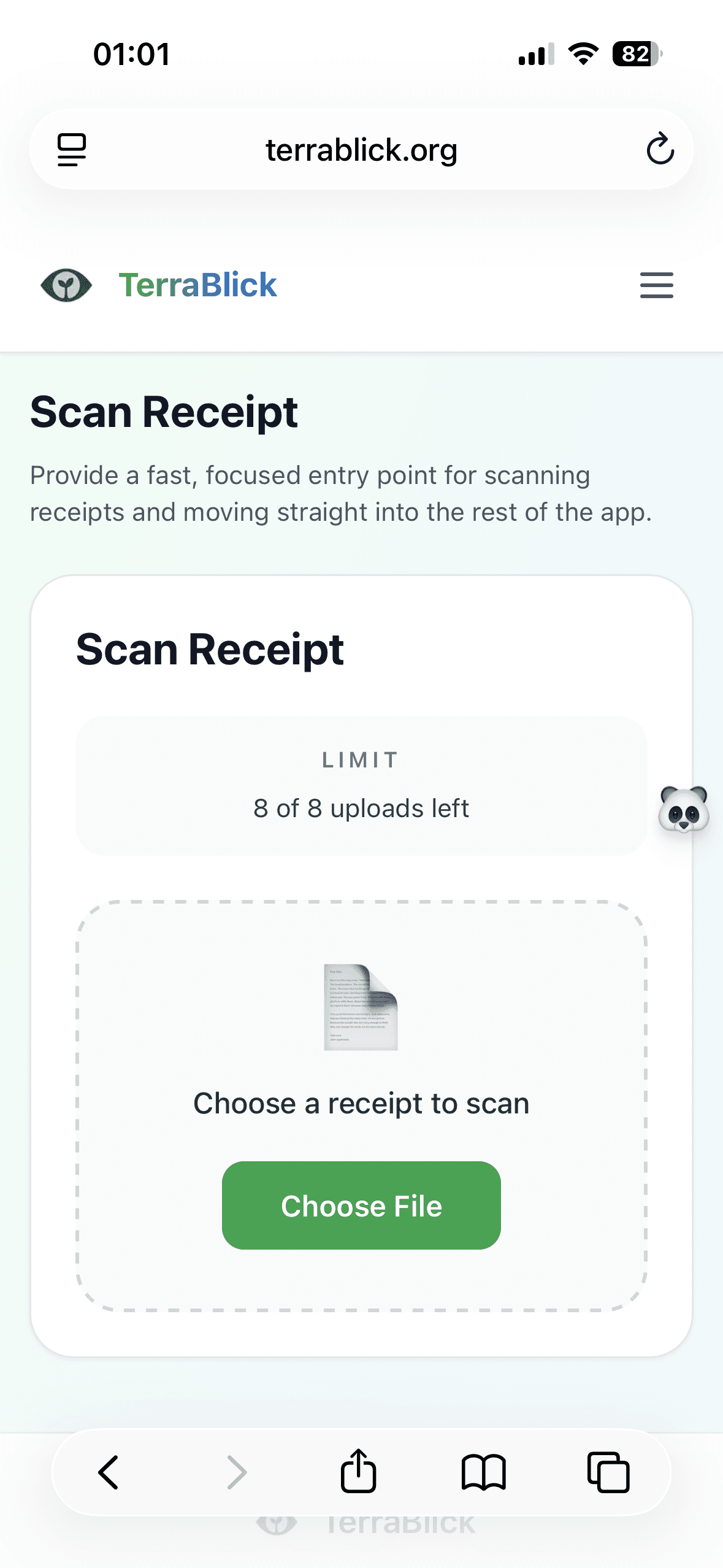
TerraBlick receipt upload interface
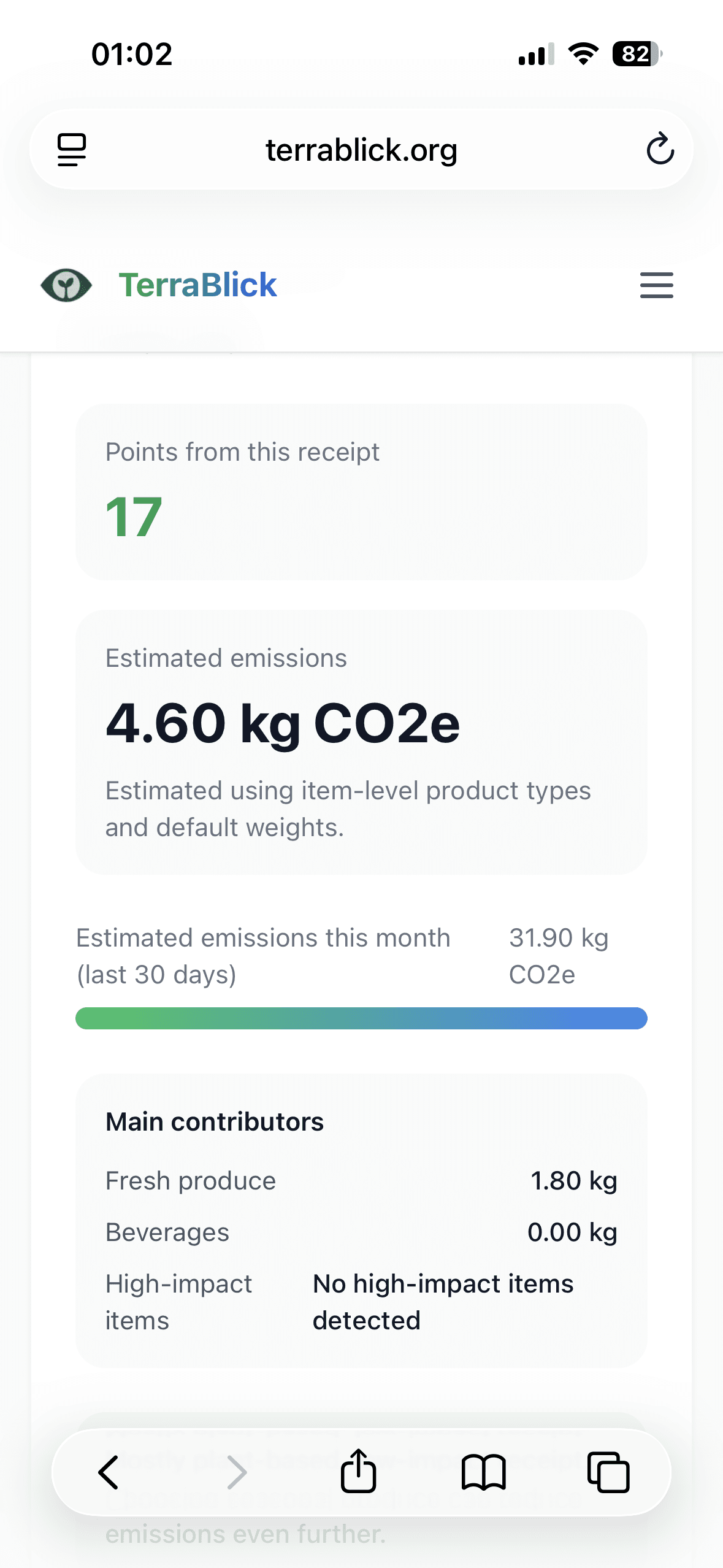
TerraBlick sustainability insight interface
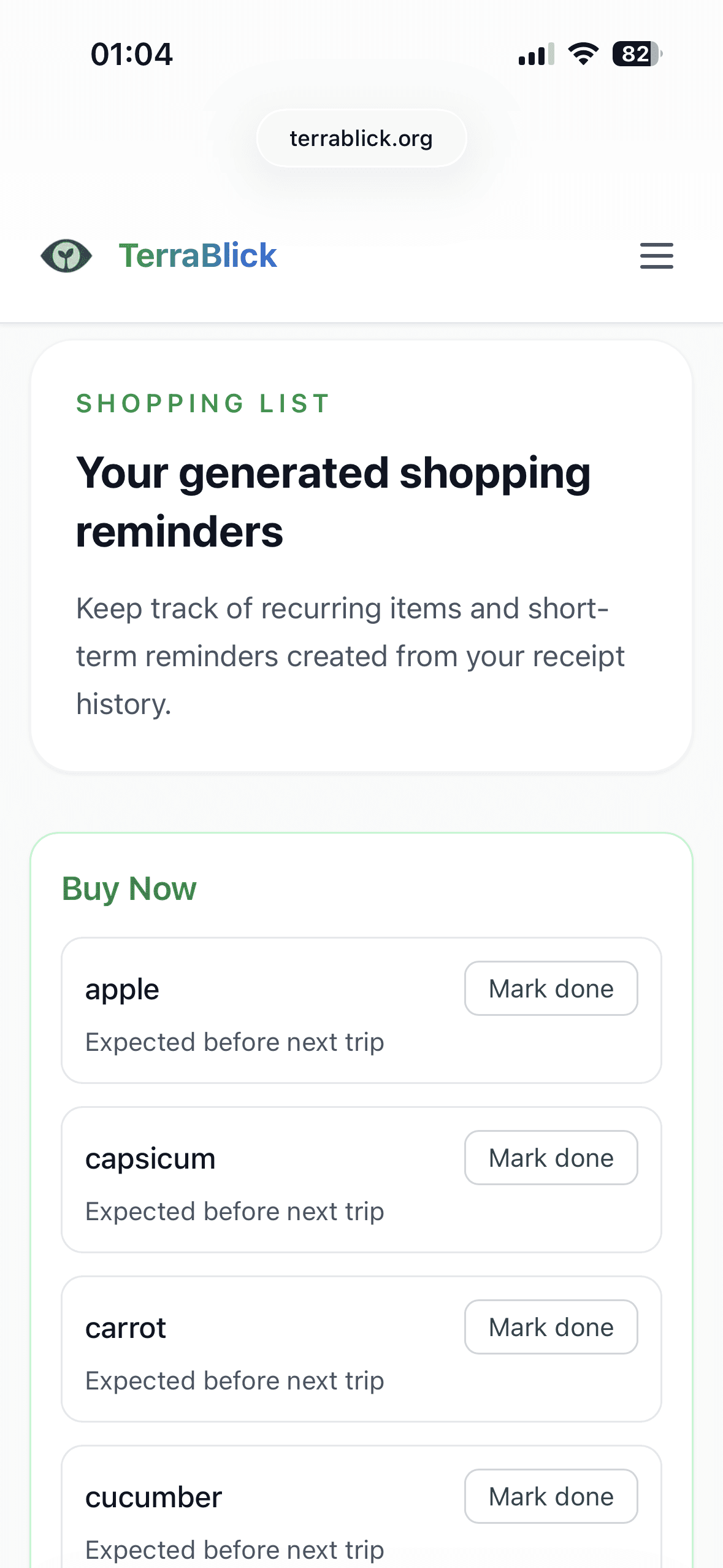
TerraBlick smart shopping list interface

07 / UX & interface

Clarity before density

Early flows were explored in UX Pilot and refined in Figma before implementation. The goal was not visual novelty; it was making a technically uncertain process feel understandable.

The interface prioritizes clear language, visible processing states, accessibility, and explicit communication of uncertainty.

Problem

OCR, scoring, and predictions can easily overwhelm a user with implementation detail.

Decision

Reveal the result in stages and use familiar product language instead of model terminology.

Implementation

Figma-defined flows become responsive React views with accessible states and explicit uncertainty labels.

Outcome

The product communicates what happened, what it means, and what the user can do next.

08 / Scaling & evolution

Built for replacement, not prediction

The goal is not to predict the future, but to ensure today's assumptions can evolve without rewriting the system.

Stateless domain services

API instances can scale horizontally because workflow state lives in PostgreSQL and external services.

Pure decision engines

Reminder rules can be tested across edge cases without a database, framework, or network.

Provider boundaries

OCR and model integrations are stages in a pipeline rather than domain concepts.

Schema-backed history

Normalized receipt items create a durable base for new insights without re-reading every source file.

09 / Roadmap

Looking Ahead

Future directions for TerraBlick

  1. 01Current

    Receipt Intelligence

    Turn receipts into sustainability insights and personalized shopping recommendations using OCR, AI, and product normalization.

    Completed
  2. 02Next

    Utility Bills

    Support electricity, gas, and water bills to build a broader view of household consumption.

    Planned
  3. 03Next

    Mobility

    Add public transport, fuel purchases, and travel data alongside household sustainability signals.

    Planned
  4. 04Future

    Household Sustainability

    Unify shopping, utilities, and mobility in one dashboard with richer long-term analytics.

    Vision
  5. 05Long term

    AI Sustainability Coach

    Help people understand patterns, discover practical improvements, and make more sustainable decisions over time.

    Vision

Direction without dates: every milestone remains subject to evidence, privacy review, and validation.

10 / Honest constraints

What is not solved yet

A useful case study should include the edges of the system, not only its center.

01

Emissions are estimates

Current factors are heuristic, not a scientific lifecycle assessment dataset. Regional and store-specific variation is not modeled.

02

Receipts do not equal inventory

The system observes purchases, not pantry stock, consumption, travel, guests, or sudden changes in routine.

03

Normalization is incomplete by design

Long-tail products remain unknown until evidence supports an alias or family rule. This protects downstream behavior from false matches.

04

The migration is incremental

Some workflows still live in Next.js route handlers while domain services move toward the layered NestJS API. Compatibility matters during that transition.

11 / Reflection

Make uncertainty visible. Keep rules inspectable. Design every boundary to change.

Building TerraBlick required much more than implementing software. It involved product thinking, cloud architecture, AI integration, system design, and continuous iteration.

TerraBlick continues to evolve, but its core principle remains unchanged: make sustainability understandable through transparent engineering rather than opaque automation.

Engineering is ultimately about making complex systems understandable—for both computers and people.

Visit TerraBlick